Another view of March: Windy (in Chicago and in Toronto — at Jilly’s strip club)

Standard
wind-trumpet-web

March “was a lousy month to exist on the South Side of Chicago… March was the final fart of winter.”

So declared the late John Powers in his novel The Last Catholic in America.

John grew up around the block from me on the South Side of Chicago, and the Last Catholic is a book about our neighbourhood.

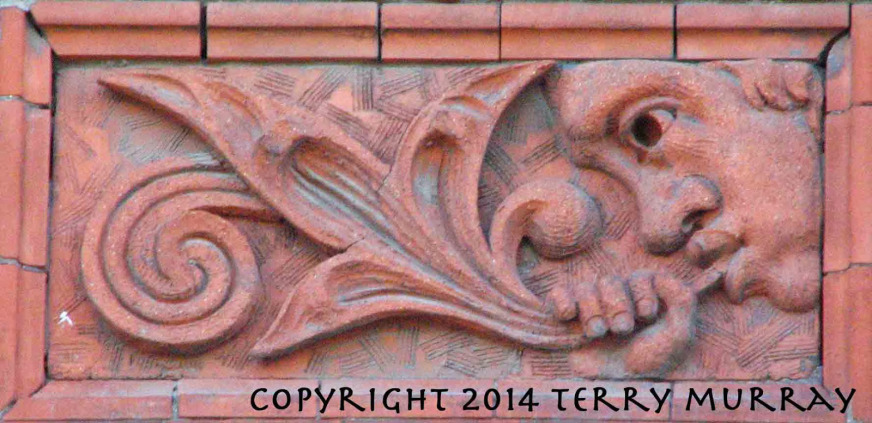
March is known for wind — the kind needed for kite-flying, as well as the meteorological flatulence Powers described — which is why I chose this terra cotta relief from a building in central Toronto to illustrate it. (More about the building later.)

Powers continued his description of this transitional month: March “would rain on us one day, freeze us the second day, and on the third day blow us off our feet. By the end of the month, we were globs of wind-wracked ice… In March, we would go to school … dressed in fur-lined raincoats, cleated shoes guaranteed not to slide on ice-glazed sidewalks, and bricks in our lunch boxes so we wouldn’t blow away.”

duelling-winds-web

These terra cotta pieces, and others like them, appear on a building that started life in 1893 as an office building known as Dingman’s Hall. Located at the corner of Broadview and Queen Street East, it was built by Archibald Dingman, who had a varied business career — but not as varied as the uses to which this building has been put.

Dingman’s Hall was a meeting place, with rooms rented out to visiting Shriners, Masons and others. Later, the building was known as the Broadview Hotel. It is currently a boarding house — the New Broadview Hotel — but is generally referred to as Jilly’s, the name of the strip club on the first floor.

When Archie Dingman owned the building, he was a partner in the Comfort Soap Company. He was also associated with the Scarboro Electric Railway and a firm that built coaster brakes for bicycles, before moving west to Alberta and getting into the oil industry, according to his obit. He died in 1936, two weeks shy of his 86th birthday.

Most of what I’ve read about Dingman overlooks an unexpected accomplishment: In 1899 (or thereabouts), he somehow crossed paths and teamed up with composer Davenport Kerrison and wrote the lyrics of “The Flag That Bears the Maple Leaf.” Although the song predates by more than 60 years the introduction of the new Canadian flag bearing the maple leaf, it probably referred to the maple leaf insignia worn by Canadian soldiers during the Boer War:

The flag that bears the maple leaf,
Entwined about thy brow shall be,
An emblem that beneath its folds,
No slave shall cry for liberty;

REFRAIN
Hurrah, boys, Hurrah!
For Canada, Hurrah!
No harm to her can e’er befall,
No danger great shall us appall,
While our prairies grand and Egypt’s sand,
Tell how our heroes fall…
Tell how our heroes fall.

The Saxon force, the Celtic fire,
Grand heritage that thou dost own,
Make bold the Lion’s brood and strong,
To front and brave the world alone,

REFRAIN

On many field of carnage red,
Stern duty’s call thou hast obeyed,
And while they daughters sad-eyed wept,
Thy sturdy sons have hist’ry made,

REFRAIN

Should foes again our land assail,
Or traitor’s foot her soil profane,
In serried ranks with iron front
We’ll steadfast stand and not in vain,

REFRAIN
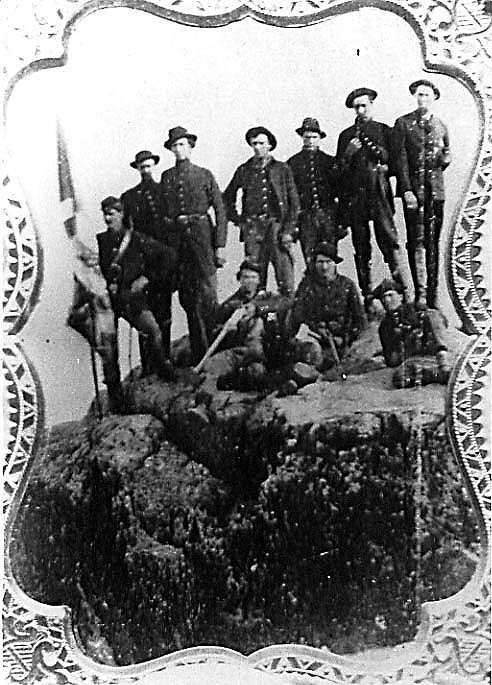
A Civil War remembrance

Standard

d3f45-lookout2bcopyToday is Remembrance Day (or Veterans Day for you American readers), which was begun after the First World War. So, in a departure from gargoyles and architecture, I’d like to write today about my great-great-grandfather Adolph Redick, who fought on the Union side in the U.S. Civil War.

He didn’t die in a Civil War battle, but a battle of another sort, the story of which has been pieced together by the joint efforts of my sister the genealogist and me.

Adolph Redick was born in Posen (then in Prussia) in 1827. A stonemason (I guess this is related to the usual theme of this blog!), he emigrated with his wife Christina to Chicago sometime around 1860.

In 1864, Adolph’s friend John Stubenbeck encouraged him to enlist in the 51st Illinois Volunteer Infantry, Company K. (That’s a picture of some of the men of the 51st Illinois, Company K, at Lookout Mountain near Chattanooga, Tennessee, above. I checked with an archivist at the United States Army Military History Institute in Carlisle, Pennsylvania, which holds the photo, but was told that none of the men is identified in the picture. So I just imagine that GGGrandfather Adolph is among them.)

During the Battle of Franklin (Tennessee), which has been described as “second only to Gettysburg in importance during the entire war,” he was clocked in the head with the barrel of a Confederate rifle:

“While making a charge on the enemy we were attacked by some infantry hidden behind a rail fence. Redieck (sic) received a blow on his head with the barrel end of a gun which stunned him and he dropped. I, being a neighbor of his at home and had induced him to enlist, I assisted him as much as I could and looked for him to be placed in an ambulance. A week or so later he performed his duty again,” Stubenbeck said in support of Adolph’s disability application (“Proof of Incurrence of Disability”) more than 20 years later.

According to the “Declaration for Original Invalid Pension” completed in 1885, Adolph also contracted malaria while on duty in New Orleans in 1865, resulting in “dropsy and general debility.” He was treated at regimental headquarters up to the time of his discharge, and “ever since then.”

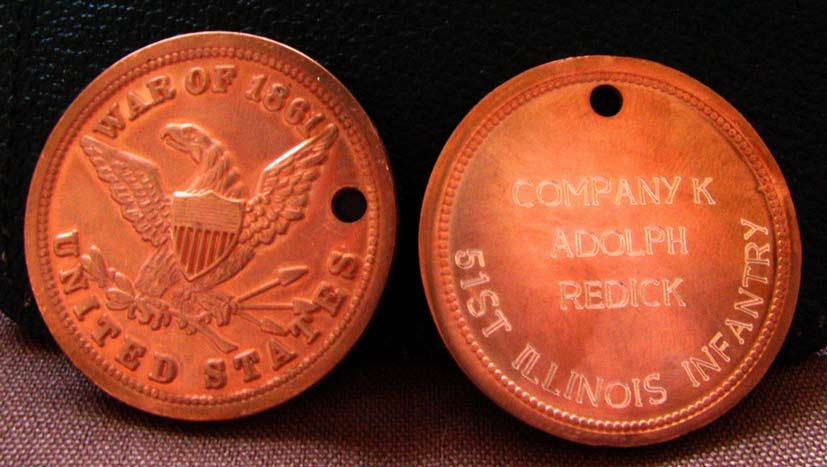
17a8b-frontback(Adolph entered the 51st Illinois as a private, and mustered out as a corporal at the end of the war in 1865. Above is a photo of a replica of his dogtag.)

Once home, Christina reported that he grew increasingly “irascible,” according to my conversation with a cousin, Adolph’s great-granddaughter. Christina ultimately had him committed to the Cook County Insane Asylum at Dunning in 1886, where he died of a hemorrhage three years later.

In his statement, Stubenbeck also said, “I believe the blow (from the Confederate rifle) was what made him insane and caused his death.”

A “Claimant’s Affidavit,” completed (with assistance) by Christina on 15 November 1898, tells the story of his commitment to Dunning: “My husband was sick on bed until the last eight months of his life. He was complaining ever since he returned home from the war of sickness, mostly about his severe headache. His only brother who died two years ago living in close neighborhood took him often to doctors, dispensaries, etc. The only doctor I had to go along was the County Physician Dr. Bluthardt who send him to the Insane Asylum in 1886. He died in 1889 there. It was my brother in law who attended to my pension claim in 1890. I cannot speak English whatsoever so I left everything to him.”

According to Dunning records, he was buried in the asylum’s cemetery.

Dunning, like many similar institutions of the time, was a scary and shameful place to be associated with. In his book Challenging Chicago. Coping with Everyday Life, 1837-1920, Perry Duis (a history professor at the University of Illinois at Chicago), wrote:

“For many generations of Chicago children, bad behavior came to a halt with a stern warning: ‘Be careful, or you’re going to Dunning.’ The prospect sent shivers down the spines of youngsters, who regarded it as the most dread place imaginable… Dunning … evoked images of gloomy institution walls, the cries of the insane, and the hopeless poor peering from its window.”

Adolph’s reward for winding up in Dunning? His son changed the family name from Redick to Richard.

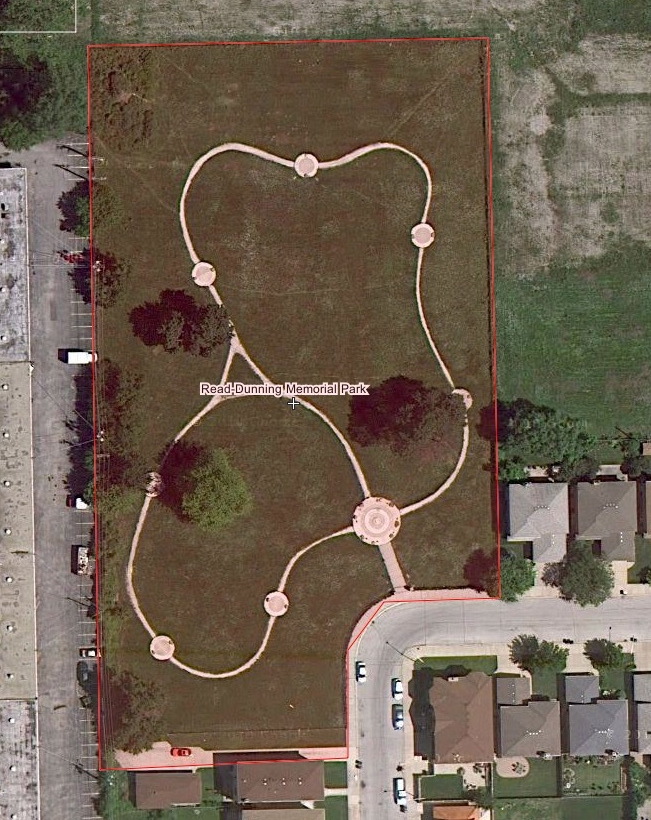
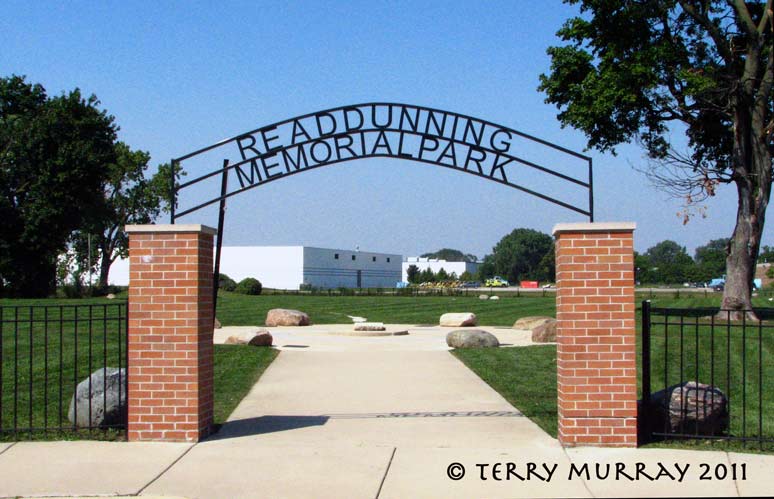
But there was another indignity to come. Dunning officially closed on 30 June 1912, and reopened the next day as Chicago State Hospital. It later became the Chicago-Read Mental Health Center. The asylum’s graveyard was forgotten until excavation for a commercial-residential project on the site was begun in the late 1980s. The crews working on the site found skeletal remains and a mummified corpse, and a “cemetery genealogist” (according to a Chicago Tribune story) estimated the cemetery that stood there contained 38,000 bodies. It was determined that it had been the public burial ground for the indigent and mentally ill from nearby poorhouse-insane asylum complex. Owing largely to the efforts of Rev. William Brauer, the remains were transferred to five acres of state-owned property nearby and made into “Read-Dunning Memorial Park.” It features eight markers indicating the groups who are buried there, including “insane asylum,” “orphaned/abandoned children,” and unclaimed corpses from the Great Chicago Fire.

2aaa7-dunning2baerial2bcropJurisdiction of the park – and hence, responsibility for maintaining it – has been in dispute, but the cause of preserving it has been taken up by a local group. On the day I visited in September, the lawn was freshly cut.

28407-dunningblog

The mysterious, magical Farcroft

Standard

This little guy is the keeper of the key to an unusual building on the north side of Chicago. The Farcroft Building in Rogers Park is reportedly the northernmost highrise building in the city. Construction of the 13-storey building began in 1928, the work of architect Charles Wheeler Nicol. The Farcroft was built with 84 three-, four- and five-roon suites. Maybe this fellow was one of the original tenants:

The Farcroft is adorned with about a dozen grotesques, including these characters:

Not much appears to be known about this building. Even the architect who is working on restoring the Farcroft has posted a request for information on an architectural history listserv, including the location of Nicol’s archive, if one exists. The dearth of information seems remarkable since Nicol designed more than 1,200 buildings, largely in the U.S. Midwest. Then again, being prolific is no guarantee of being remembered.

There’s more to doing research than Google searches and finding what’s on the Internet, but from Toronto, that’s the only way I’m able to research a Chicago building. Here’s what I’ve turned up about the Farcroft:

A Chicago Tribune article from February 1928 — admittedly, before the building had even begun — described, only cursorily, the exterior, not mentioning the faces at all. The interiors were described in a bit more detail:

“Color will play a prominent part in interior equipment and decoration. For instance, the kitchens will have colored tiled walls, to match the cheerful hues manufacturers at last are putting into culinary utensils and kitchen furniture. Several bathrooms will have gay tinted tubs to splash in, with walls and fixtures to match.”

David Blixt, a Shakespearean actor, writer and former tenant of the Farcroft, wrote an intriguing, provocative post on his blog of building lore he picked up from other tenants and the company that formerly owned it. Nicol, Blixt said, “fancied himself a magician, and wanted the building to be a nexus for mystical energy.”

None of the rooms in his apartment had right angles, “the better to funnel the ‘mystic’ energy.”

When he and his wife moved in, they met another resident in the elevator who gave him a business card and said, “This is the name of my exorcist. He did a wonderful job.”

I suppose some sinister, mystical, magical energy could be expected at a 13-story building located at 1337 West Fargo Avenue.

And this wizard appears at each storey up the front of the building:

I’ll post any additional information I get. In the meantime, Happy Halloween, everybody!

Who knows what evil…

Standard

… lurks on the walls of Chicago apartment houses?

So, last summer, my sister and I were driving around Chicago, attending various family reunions. (Actually, they were newly discovered family, so they weren’t so much REunions as… I guess, just unions.) Anyway, while we were driving I noticed the flute player on this house, and asked my sister (the driver) to stop so I could shoot it. (She’s getting used to this.)

I did a little research and learned from Robert Powers’s excellent blog, A Chicago Sojourn, that the same developer responsible for the flute player had also incorporated the Three Wise Monkeys “see no evil, hear no evil, speak no evil”) on other buildings.

But why? Thanks to the digging that Powers did, the answer seems to be simply: “Because.” The headline of a Chicago Tribune article from 1956 says it best: “No reason, but monkeys adorn dwelling units.”

The story says that Angelo Esposito, president of the general contracting firm that built the house and apartments, had always put sculpture on his buildings. The monkeys were chosen “for no special reason,” he said, but added, “The fact that it has created talk and interest, tho*, indicates the idea accomplished what it was meant to do.”

I have a special fondness for the “hear no evil” monkey, who clearly is open to hearing anything and everything:

*Back in the 50s and 60s, and probably before and probably since, the Chicago Tribune, no doubt like other newspapers, used to use these shortened versions of words (e.g., tho, thru) to save space. So I never understood why the Trib insisted on using “clew” in its headlines. That “w” takes up a huge amount of space.

Lute Lady

Standard


My mother died 19 years ago tonight, far from her Chicago home. At about the time she died, my sisters and I discovered a nifty way to memorialize her in her old North Side neighbourhood.

The Mid-North Association, a Lincoln Park area civic group, began selling personalized bricks with which to repave a park known variously as Mid-North Park and the Belden Triangle, and to rehabilitate it somewhat. For U.S.$60, we had two lines engraved that said, simply, “Maggie Murray” and “I Miss Chicago.”

On my next trips to Chicago after ordering our brick, I would visit Mid-North Park to see whether it had been installed yet. I finally found it – quite near bricks bought by local businesses she used to patronize, as well as Bill Kurtis, the TV newsman she so admired.

Whenever I’m in Chicago, I still make a little pilgrimage to that park.

But in the intervening years, the park has changed. At the time of the brick-laying, it featured a beautiful sculpture of a veiled woman playing the lute, with two children on either side of her. A few years ago, I noticed that the sculpture was gone – replaced by a (forgive me) rather uninspiring fountain. It was installed as part of a beautification project to renovate or construct 18 fountains in parks, triangles formed by some of the city’s weird intersections of three streets, plazas and other open spaces.

I think Mid-North Park/Belden Triangle got one of the more pedestrian fountains. But I always wondered what happened to the sculpture.

I decided to seize the moment, probably prompted by the anniversary of my mother’s death, and contacted Chicago Park District (CPD) historian Julia Bachrach. She directed the years of research that resulted in the Chicago Park District Guide to Fountains, Monuments and Sculptures, an impressive online resource providing the histories of those features in CPD parks.

Julia told me that the sculpture I was interested in, known as “Lute Lady” or “Seated Woman With Children,” was originally part of a bandstand in Lincoln Park designed by Chicago architects Pond & Pond, and sculpted by Lorado Taft in 1915.

The Lute Lady has had a rough ride. In 1983, she and other sculptures were found along Lake Michigan, north of 39th Street, where they were waiting to be used as landfill! Julia sent me a story from the Chicago Tribune (6 May 1983) describing the find, which included columns from the city’s old federal courthouse building and the bas relief backdrop to “The Spirit of Music,” a memorial to Theodore Thomas, founder of the Chicago Symphony Orchestra.

The Trib article quoted Ben Bentley, then the CPD’s director of public information, saying that the CPD warehouse had become too crowded with materials that no one had asked about. The sculptures were going to be used as part of a landfill to help retard lakefront erosion.

“What we have done is a perfectly legitimate thing,” Bentley is reported to have said at the time.

Since then, the Federal Building columns and the conserved “Spirit of Music” have been installed in Grant Park, Julia said.

And what of the Lute Lady and her children? “They are currently in storage, which is probably a good thing, because they are marble and really shouldn’t be outside in the Chicago climate,” she added. “We really need to find a good indoor location for the Lute Lady.”

As to the photos in this post: I’m not sure whether they’re mine or were taken by my sister Roxe Murray. We shared our prints back then – at least the ones relating to our mother’s memorial and family history. Somewhere in my cluttered home office, I have a full photographic study of the Lute Lady, shot from a variety of angles. I’d like to think I was prescient when I took those photographs, but I probably just wanted to fully document my mother’s memorial. When I find those prints, I’ll scan and post them.

Time and place

Standard


Having spent 10 days in Chicago and with two weeks more off from the day job, I decided to play tourist in Toronto. So I took a double-decker bus tour.

I am as interested in music as the next person — possibly more so, since I used to be a semi-professional musician in another life — but I’ve never felt the need to be, literally, constantly plugged into the soundtrack of my life. (Neither have I felt the need to be constantly on the phone, but that’s a post for another day.)

Anyway, as I was saying before I interrupted myself, I believe in having a life to which the music that I hear forms the soundtrack instead of all-soundtrack-all-the-time.

When I took the coach tour, this girl who sat ahead of me clearly favoured the latter. She generously plugged one ear bud into her own ear, and the second into her mother’s ear — rendering them unable to hear the surprisingly informed and witty commentary of the tour guide.

That was their loss, and didn’t interfere with my enjoyment of the trip… although I did wonder what the point was of paying nearly $40 and then shutting out the tour guide. (I recognize that language may have been a factor in this case.)

But then the child apparently tired of her iPod — and began serenading us a series of random notes on a blue plastic harmonica, and my mood returned to that one of my stone friends in Chicago:

The strange obsessions of the gargoyle hunter

Standard

I don’t expect to get much sympathy, but truly, being a gargoyle hunter is not easy. It’s not easy on the hunter and it’s not easy on the hunter’s friends. The only person it’s at all easy on is the gargoyle (and yes, I realize I just called a stone building ornament a “person”).

If you’ve been following this blog of late, you’ll know that I spent 10 days at the end of July in Chicago with my sister Roxe, the family genealogist (whose life is also hard, but I’ll her get her own blog to complain about the travails of the family-hunter). We attended one arranged family reunion (the Murrays) and a dinner Roxe organized with a few members of the Kalodimos side of the family.

As you can sort of tell from this map of Chicago* I posted in our hotel room, replete with little Post-It flags showing all the places we had to go, we had some ground to cover. For reasons too complicated to go into here, Roxe did all the driving and I did all the navigating. But everywhere we went, I was checking out buildings for interesting faces. (While I was navigating – which is easier and safer to do than gargoyle-hunting while driving.)

To her credit, Roxe did not wring my neck, although she did ask several times, “What?! What happened?! What are you looking at?!” thinking a crime in progress or a crash site had caught my attention.

She also agreed to drive up and down Clark Street so I could find this fellow

who I shot when I was in the city in 2004. On that trip, I rode the #22 Clark bus all the way to the northernmost end of the line, way past Diversey where I lived for a short time. (Sorry to bore those not familiar with Chicago with these details.) It was a long ride, up to Devon (which Chicagoans mispronounce). It was on that bus ride that I saw this guy, hopped off and shot him (and a partner he had on a neighboring building) and I thought it would be fun to find him again and reshoot him.

We drove up and down Clark Street three times — and I never saw him or his friend. Who knows what happened to my stone friends? I fear his building may have been torn down in the intervening six years. I actually felt bereft… until Roxe had enough of Clark Street and announced that we were going to do some actual genealogy work, whereupon she turned into one of the cemeteries just off Clark where our maternal grandparents are buried.

* A common feature of Chicago maps is the truncation of the South Side. To any Chicago mapmakers who might be reading this: give us back the South Side! It should be possible to put the whole of Chicago on a map. Besides, the South Side is an important part of the city. When was the last time the North Side baseball team won a pennant, never mind the World Series, hmmm?

Faces in the ‘hood

Standard

While in Chicago for the family reunions and genealogical research, we stayed in a Days Inn in Lakeview, the old neighbourhood (where I lived for a time way back in … never mind). I wandered around and found a bunch of faces and gargoyles I never noticed when I lived there. But of course, I lived there before my gargoyle awakening.


They’re everywhere! I don’t know what these buildings were originally – I’d research them if I weren’t working on another book – but they were highly decorated.

Chicago cemetery sculpture

Standard

My visits to Chicago cemeteries were largely to find and record the gravestones of distant and not-so-distant relatives, all of whom had pretty unexceptional stones. But I noticed a few that I thought worth taking the time to shoot. And of course, the most striking sculptures would have to be the ones marking the graves of children…

This one (left) was for a whole section of the cemetery labelled “Lullabyland,” where mostly young children were buried. I don’t know who created it or why a child staring down a lamb was thought to be appropriate, but I do like the look of determination on the girl’s face.

This one (right), which seemed to cry out to be rendered in black and white, marked the grave of a girl named Lauretta who died at the age of seven in 1898.

The cemetery where we had no relatives at all and as a result had only 15 minutes for a quick drive-through was Graceland Cemetery where anybody who was anybody in Chicago history is buried. I’d like to take a tour of the place the next time I’m in Chicago, to see the graves of the notables and some of the fantastic sculpture there. The only figure I had time to snap (and from inside the car at that) was “Eternal Silence” by Lorado Taft which watches over the grave of Dexter Graves (yes, that’s his name), one of the city’s first settlers.

This figure is also known as the “Statue of Death,” and originally was entirely black, except for the face, hidden in the hood of the robe.
Legend has it that if you look into the face you will glimpse your own death. But legend also has it that the figure is impossible to photograph, and that cameras won’t function in its presence. It certainly is eerie, but obviously, photographable.

Note to Pamela Williams: Your cemetery sculpture gig is secure!