Deerly departed

Standard

I have just returned from a family reunion in Chicago. Actually, not having ever heard of these relatives, let alone met them, I suppose it was more of a union than a reunion. Part of the trip involved going through cemeteries and shooting family monuments (and interesting cemetery sculpture, following the lead of Pamela Williams – see links; results will be posted shortly).

We noticed a couple of bucks wandering through one cemetery, eating the flowers and whatnot, and spent about 20 minutes following and shooting… I mean, photographing them.

Yes, the first pic (top) was shot through the car windshield, but then I got out and followed them around:

Chicago Tribune

Standard


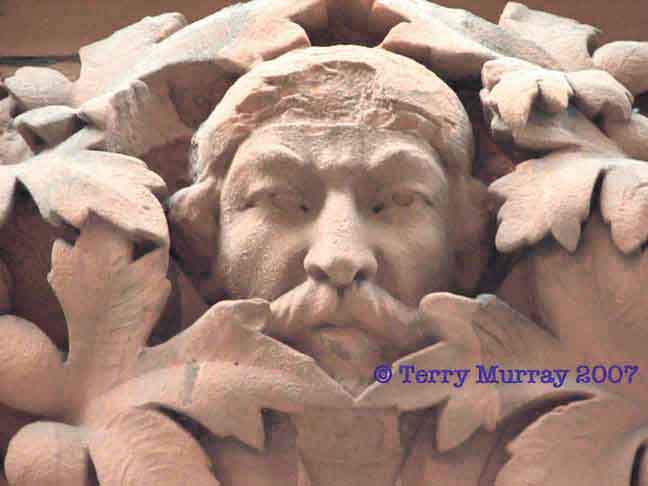
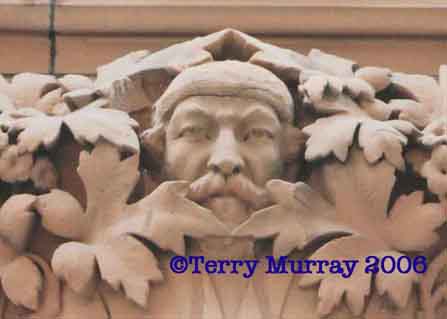
I’m still experiencing re-entry to the Day Job, after four weeks off, so forgive me (again) if I don’t expound on the future of publishing just yet. However, I wanted to continue the series of newspaper office faces. These two are from Tribune Tower in Chicago.

“Souvenir of Tribune Tower,” an undated booklet (looks as though it might be from the 1920s or 1930s) that gives the story of the building and the newspaper (and that I scored on eBay earlier this year), also describes the sculptures in and on the building.

It says that the “whispering man” (above) typifies “insidious rumour,” while the “shouting man” (below) is the “spirit of open rumour or news.”

Hmmm … not sure I ever thought of news as “open rumour.”

Studs Terkel, 1912-2008

Standard

Ah, sad news out of Chicago: Studs Terkel died today at the age of 96.

Studs was many things: an actor (most recently in “Eight Men Out,” the 1988 movie about the Chicago “Black Sox” scandal of 1919), a disc jockey, an activist and more. But he’ll be remembered best for his interviews – radio interviews with just about anybody who was anybody, as well as books of interviews with everyday people: people who lived on a single street in Chicago (Division Street: America), people who worked in all kinds of jobs (Working), people who came through the Great Depression (Hard Times: An Oral History of the Great Depression) and the Second World War (The Good War), race relations in the U.S. (Race: What Blacks and Whites Think and Feel About the American Obsession), and many others.

I’ve been listening to WFMT radio, the Chicago station where Studs had a daily show for 45 years (and was billed in the staff directory as “free spirit”), which is running old interviews by him and reminiscences about him. One of the reminiscers said that Studs had been saying for the last year or so that he was ready to go – he’d apparently been telling everyone, “I ain’t buying any green bananas!” But then last week, he said he had to live to see the outcome of the U.S. election. He was living in his own home, and his absentee ballot apparently arrived in today’s mail.

Studs was one of my own heroes when I decided to study journalism. The great thing about his interviewing style was that he was fully engaged and certainly brought his own personality to his interviews, but he didn’t dominate them. He didn’t compete with his interview subjects, and he knew when to listen and let them take flight. As I write this, WFMT is replaying his interview with the U.S. contralto Marian Anderson, and she just spoke, uninterrupted, for at least four minutes.

Someone – it’s attributed only to Newsweek magazine – said, back in the 1960s or 70s, that “No journalist alive wields a tape recorder as effectively as Studs Terkel.” And it’s also been said by several observers that Studs didn’t invent oral history – but he might as well have.

I never met him. The closest I came was on a visit to Chicago in 1992, when he was participating in mock soapbox speeches in Bughouse Square, the informal name was given to Washington Square Park where cranks and religionists and labour unionists used to hold forth. The park is across the street from the Newberry Library, which has organized recreations of free-speech gatherings each summer in conjunction with its annual book sale. I took some pictures there, and when I find them, I’ll post them, but in the meantime, I’m using the cover of his memoir that was published about a year ago. Another new Studs book – P.S.: Further Thoughts from a Lifetime of Listening – is scheduled to be released on 15 November.

You can read his obit in the Chicago Tribune here, and I found the following mp3 of his reflections on 40 years of interviews:

@import url(http://beemp3.com/player/embed.css);

Studs Terkel (c) HighBridge – Voices of Our Time
Found at bee mp3 search engine

As Studs used to sign off his WFMT show: “Take it easy, but take it.”

More Chicago

Standard

But not the University of Chicago, which actually has way more gargoyles than I posted here.

This architectural doodling (above) is on the former Richmont Hotel, now a Red Roof Inn. (How could they stick a class joint like this with the name “Red Roof Inn”? Even if it is a Red Roof Inn?)
The fellow melting into the awning down at the bottom can be viewed better here:

I didn’t actually stay at the Red Roof Inn. Not on this trip anyway. (I stayed there when it was the Richmont back in aught-84 or so.) Nope, this time I stayed around the block. But it struck me that the Richmont/Red Roof guy looked a bit like he might be related to these guys up in Lincoln Park:


Maybe. Then again…

University of Chicago: Gargoyle Central (part 2)

Standard

So I strolled along 57th Street from the Medici, truth to tell, looking for a pay phone so I could call a taxi to take me back to my hotel and then to the airport. (There didn’t seem to be any taxis just cruising by.) A cell phone was forced upon me by my sister last fall, but alas, it works in only Ontario and Quebec. (Yes, yes, it probably works elsewhere, but I haven’t figured out how.) When I arrived at Regenstein Library, I though, “Surely there will be a pay phone here.” Not so. But a kindly woman at the information desk let me call on her phone.
As I waited outside for a taxi that never showed, I noticed the U of C’s Hull Gate across the street, with its procession of undergraduate gargoyles, aspiring to the status of graduate.


Here is the terrified freshman. I almost looked like this when the taxi did not arrive. Then I became apoplectic. Then I grew resigned. I am still sitting outside Regenstein.

University of Chicago: Gargoyle Central (part 1)

Standard

I was in Chicago a week or so ago for a neurology conference (no big deal – it’s not like it’s brain surgery!), and decided to swing by the University of Chicago neighbourhood to take a look at Walter Arnold’s gargoyles on the Medici on 57th, a campus pizza restaurant. I particularly wanted to see his coffee drinker, but the caffiend also has a pizza-eating brother.

Walter is a busy stone carver/sculptor whose work also appears on Tribune Tower in Chicago and National Cathedral in Washington, D.C.

More on the University of Chicago gargoyles to follow…

Christmasy but creepy?

Standard


This fellow and five of his brothers appear on the now-closed Village Theatre in Chicago. This whole figure—especially his tangle of musical instruments—has always struck me as Christmasy. I think he reminds me (without the instruments) of Marley after he’s removed the bandage that keeps his jaws shut.
But he’s sort of creepy too, which detracts a bit from his Christmasy aspects.

A chip off the old…

Standard

6a5bc-confed-chipcopy…John Kay Macdonald, founder of Confederation Life.
He was immortalized on the south side of the original Confederation Life building at Richmond and Yonge, along with portraits of three of the architects.

When I led a small but enthusiastic Faces on Places walking tour past the building on Saturday, we noticed that JK was missing a chunk from his cap.
It’s a designated heritage building, so I’ll look into whether there’s any way to get JK repaired.a512a-confedcopy

MARINA CITY UPDATE: Lynn Becker, on his ArchitectureChicago PLUS blog, reports that the Marina Towers Condo Association Board has passed its wrong-headed rule requiring people who want to photograph and publish images of Marina Towers to seek its permission and pay royalties. Only now it’s citing trademark law rather than copyright. Lynn, a Marina City resident, is so fed up that he’s said he won’t write about this subject again “unless the MTCA board is actually stupid enough to try to enforce it.”

Go ahead and shoot

Standard

0a5b3-marinastop
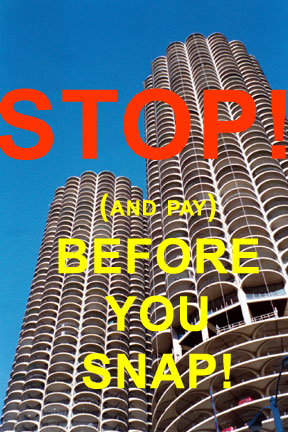
Thanks to Lynn Becker, a writer on Chicago architecture, for letting me use this image (which he created) and for bringing attention to a ludicrous situation that many architectural photographers have run up against in other places. The condo association at Chicago’s iconic Marina City towers, in a move he describes as “equal parts loony and arrogant,” wants photographers to get the association’s “express written permission” to take pictures of the building. The association says that because of “the architectural significance of our building,” it holds a “common law copyright on the use of the Association name and building image,” under state and federal law.
In fact, copyright is an area of federal law, in the U.S. and in Canada, and neither piece of legislation forbids taking and publishing pictures of buildings. I had reason to check that area of Canada’s Copyright Act when I started shooting in earnest for Faces on Places when someone cautioned me against shooting her building. I know of at least one other Toronto architectural photographer who has also run up against that.
For the full story, see Lynn’s ArchitectureChicago PLUS blog (see Links in the left column).
Lynn (who I bet gets more mail addressed to Ms. Becker than I do for Mr. Murray) lives at Marina City and says the association board is going to vote on this groundless rule on 15 November. If it passes, he challenged the board to come after him for shooting and posting or publishing photos of the building. “If you’re so dead set on embarrassing the building, the board, its residents, and – come to think of it – the very notion of intelligent human life, I will be a willing co-conspirator in getting your buffoonery the widest possible audience,” he wrote.
Glad to help you, buddy.

Small world

Standard

d78ef-onelioncopy
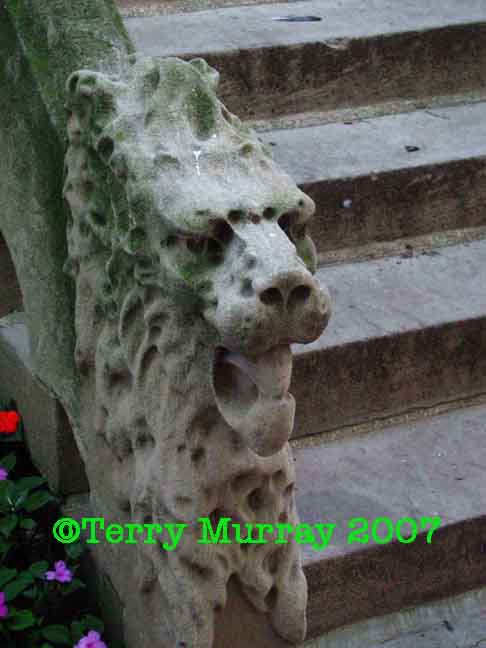
I came home from a conference in Chicago in late September with two 1GB memory cards full of pictures—pictures from the conference as well as the gargoyles and other architectural critters I found. Somewhere between my study and a friend’s car, waiting at the curb, I lost one of the cards. Sugar and I retraced my steps three times, and he took the back seat out of the car twice—but still no card. Until yesterday… when I found the bloody thing in the magazine basket in my living room. It must have flipped out of my hand or pocket somehow as I was walking out, and landed neatly in the magazine rack that I never use and noticed only because I bent down to pick up one of the cat’s toys which had come to rest in front of it.
Either that or the cat gently dropped it in the magazine rack after batting it around the apartment for the last six weeks.
390d9-lionporchcopy
The headshot files on the card were no good to me now, seeing as I’d already written the stories that they would have illustrated. But I was glad to be reunited with my architecture pictures.
Such are the hazards of miniaturization—or having a jealous cat.